
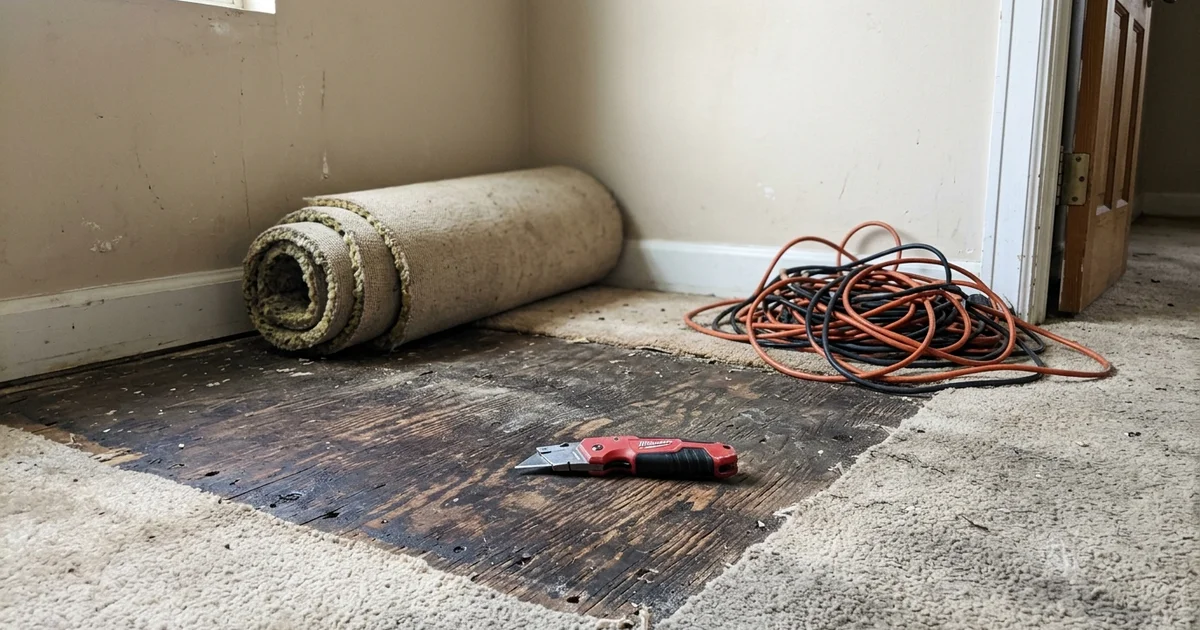
The question behind almost every call
Somebody cleaned the room. Possibly professionally. The carpet was shampooed, the surfaces were wiped, an air freshener went in, and for about a week it seemed resolved.
Then a warm day arrived and it was back, exactly as before.
That is not a failure of effort. It is a failure of sequence, and it happens because the source of the odor was never in the room. It was under it. Resolving it properly is Unattended Death Cleanup work, and this guide explains why.
Where the fluids actually go
Human decomposition releases fluids that behave like any other liquid on a permeable surface. They move downward and outward, following gravity and capillary action.
| Layer | What happens |
|---|---|
| Carpet fibres | Absorb and hold, visibly stained |
| Carpet padding | Acts as a sponge, retains far more than the carpet above |
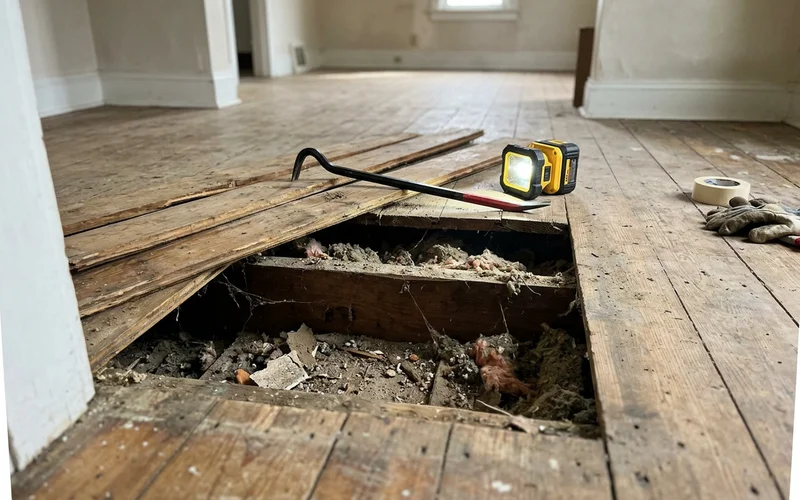
| Subfloor | Plywood, OSB, or plank absorbs into the grain and between boards |
| Joist cavity | In extended cases, fluid passes through seams and reaches framing |
| Drywall | Wicks upward from the floor line where contact occurred |
The visible stain is the top of the problem, never the extent of it. In Cleveland’s older housing stock, tongue-and-groove plank subfloor is common and it is particularly absorbent, with seams that carry fluid laterally well beyond the visible area.
The rule of thumb we use on site
Whatever the surface shows, assume the material beneath it has more. We cut back to clean substrate rather than to the edge of the stain, and the difference is often a foot or more in every direction.
Why odor molecules are so persistent
Decomposition produces a set of volatile organic compounds, including cadaverine and putrescine, that human beings detect at extraordinarily low concentrations. Evolutionarily that makes sense; practically it means a quantity of residual material far too small to see is more than enough to be smelled.
Those molecules bind into porous material and re-release as temperature and humidity rise. This is precisely why a room seems fine in a cool, ventilated October and is unbearable when the furnace runs in January. Nothing changed except the conditions that free the molecules.
Why cleaning cannot reach it
Three reasons, each sufficient on its own.
Depth. No surface-applied product penetrates plywood subfloor to the depth fluids reached. Contact time and dilution are irrelevant if the chemistry never arrives.
Chemistry. Detergents lift and suspend soil. Odor compounds bound into cellulose require enzymatic breakdown, which is a different mechanism entirely.
Masking versus removal. Air fresheners and deodorizing sprays add compounds to the air. Some react with the existing odor to create something worse. None of them address what is in the floor.
What actually resolves it
The order is not negotiable.
- Remove the saturated material. Carpet, padding, and any flooring that fluids penetrated. Subfloor is either cut out or, where the penetration is shallower, retained for treatment.
- Treat the substrate. A bio-enzymatic cleaner breaks residual organic compounds down at a molecular level rather than washing the surface.
- Seal. Antimicrobial primer sealant over the treated substrate locks down anything remaining so it cannot re-release into the air.
- Then treat the air. Only now does a hydroxyl generator or ozone chambering do anything durable.
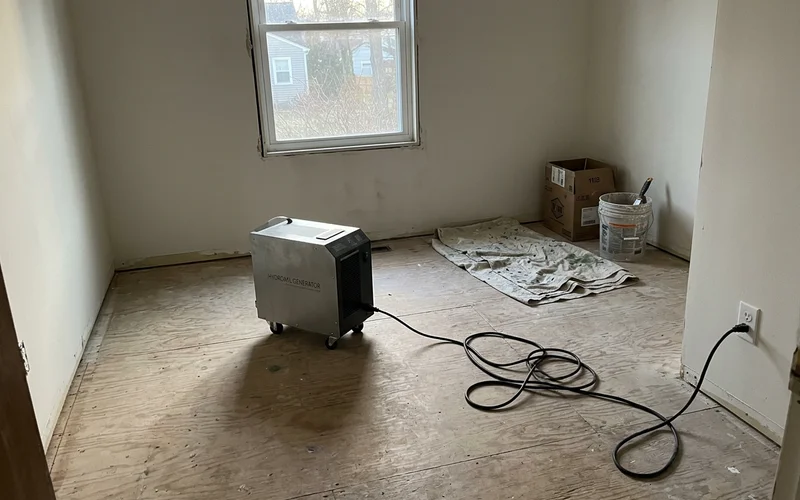
Hydroxyl generators are safe to run in occupied spaces over longer cycles. Ozone is faster and more aggressive but unsafe to breathe, so it requires a completely unoccupied and sealed property with a ventilation period afterward. Thermal fogging is used where odor has penetrated surfaces that cannot be removed.
These four steps sit inside a larger sequence of containment, documentation, and verification testing, which our guide to the unattended death cleanup process walks through from the first phone call onward.
The mistake that costs the most
Renting an ozone machine and running it over intact flooring.
It is cheap, it feels productive, and it temporarily reduces the smell because it treats the air and the surfaces it can reach. The saturated subfloor underneath is untouched. Within days the odor returns, and the property owner concludes that nothing can be done.
Something can be done. It just has to start at the floor rather than in the air.
Where structural damage is involved
In advanced cases, prolonged moisture and organic material can compromise subfloor integrity and encourage mould growth in the joist cavity. Those properties need remediation followed by a contractor, and the remediation has to be genuinely complete before anyone builds over it.
We document substrate condition and the treatment applied, so a contractor knows exactly what they are working on top of and does not seal a problem inside a wall or a floor.
For odor problems that are not decomposition-related, such as pet contamination or smoke in a rental turnover, our Severe Odor Removal service covers the same principles applied to different sources.